
How abstract art is like socks
I’m teaching my next Introduction to Abstract Painting class through the Rochester Brainery on Tuesday, July 28, at Living Roots Wine & Co. There are still tickets available—and they include wine! This class is beginner-friendly and materials are included. Click here to register yourself (and a friend or two) today!

Putting abstract art on my feet
I’m guessing you weren’t expecting a painter to write an article about socks, right?
One of the biggest misconceptions about abstract paintings is that they have an inherent meaning to figure out. Like watching clouds pass by—on a day that doesn’t look apocalyptic thanks to wildfire smoke—and finding animals or shapes or long-dead celebrities, you absolutely can find concrete images in abstract art… but it’s your brain’s hardwired need to impose order on chaos (something called “pareidolia,” if ya nasty). All brains do it because ambiguity can be unnerving or even dangerous (not in art, but, like… in the wilderness).
The art itself, though, is functioning like a mirror—it is showing you, the viewer, more about yourself than it is revealing anything inherent about itself or, indeed, its maker or their mental processes.
Stay with me here, as this is about to become a prolonged analogy. And if you’d rather not learn about socks, here’s the link to my next abstract painting class where I promise not to talk about socks (much).
As an elder millennial, I grew up with the Harry Potter series. It was one of my earliest special interests, and I was often the age of the characters when the books were released. Now, I did not expect to see the author, who used to be a personal hero of mine, become a transphobic Death Eater, but that is an issue that is beyond the scope of this brief missive.
In the first book, Harry Potter and the Sorcerer’s Stone, the 11-year-old orphan protagonist is wandering the castle at night past bedtime because that’s what children do, and he encounters a huge, ornate mirror. When he looks into it, Harry is startled because there are people standing behind him that he does not see in the room when he turns around. As he looks closer, he realizes the people look like him—and it’s the first time he gets to experience his deceased parents and extended family smiling at him.
Harry recognizes it’s some kind of strange magic, but the possibility that his family is out there somewhere keeps him coming back night after night to sit in front of this mirror. On another nocturnal visit, he is startled when the school headmaster, Dumbledore, appears quietly behind him. Dumbledore explains that this is the Mirror of Erised (“Desire” spelled backwards) and it shows “not your face but your heart’s desire.” He warns Harry that individuals have wasted away in front of it before. He says “It does not do to dwell on dreams and forget to live,” which is pretty bangin’ life advice, right?
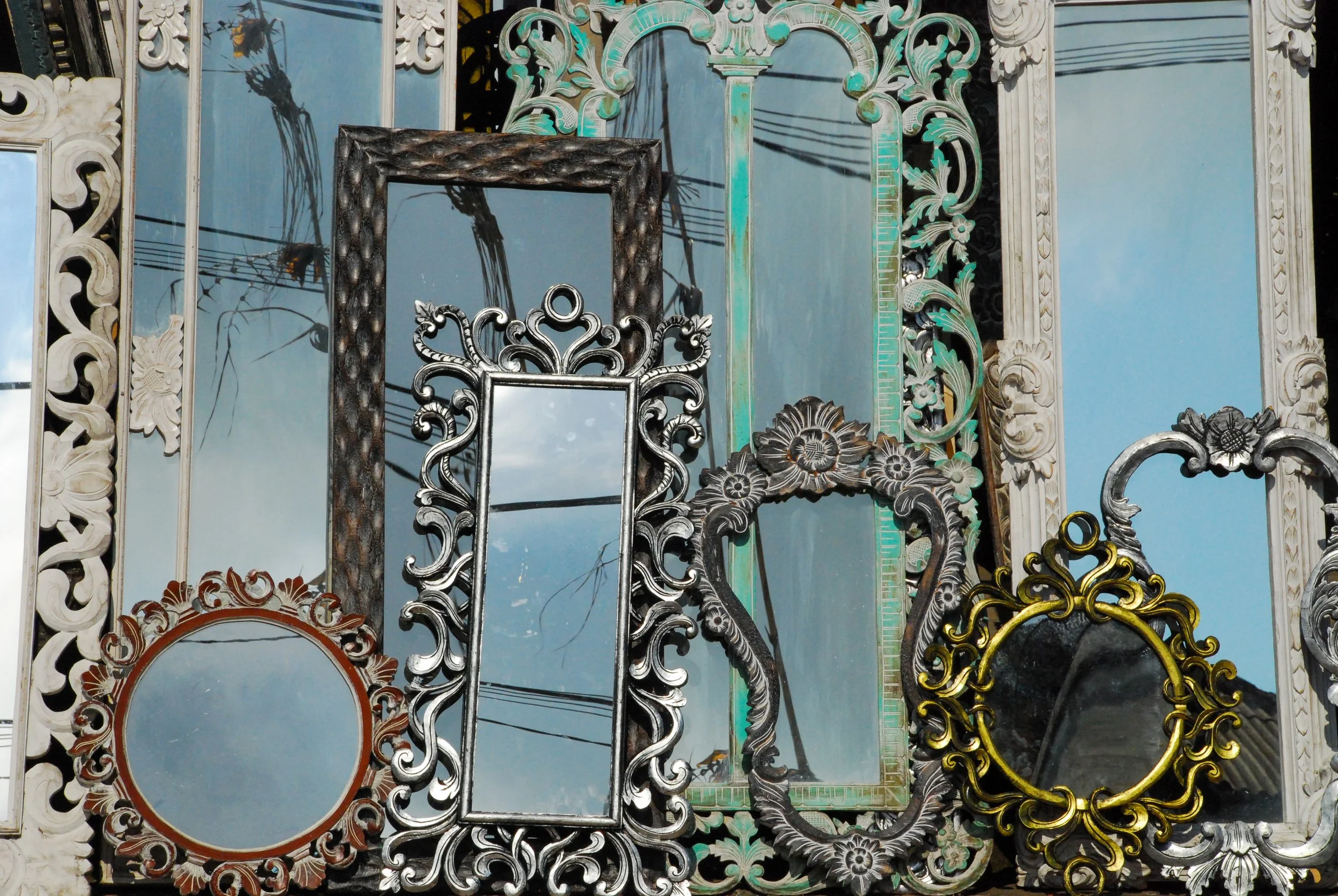
One of these could be the Mirror of Erised, and we might never know…
Harry then asks Dumbledore what he sees in the mirror. In his youthful naïveté, Harry doesn’t realize how invasive of a question this could be. The kindly headmaster says “I? I see myself holding a pair of thick, woolen socks,” explaining that “Another Christmas has come and gone and I didn’t get a single pair.” Though Harry is not the sharpest knife in the drawer, he does recognize in getting back to his dormitory that Dumbledore “might not have been quite truthful.”
Dumbledore is 110 in book one (because…magic), so even without reading the rest of the series and learning more of his tragic backstory, one may surmise he sees things in the mirror that are too personal or traumatizing to tell someone a tenth his age.
And THIS is where I connect the dots on how abstract art is like socks. (Thank you for your patience.)
The practice of creating anything is personal and can be intense. But abstraction by its very nature is often still more intimate: It can be challenging to articulate to another what you’ve made when what you’re making has no reference in the visual world. A representational painting may hold additional layers of meaning, but its surface shows every viewer the same image, perhaps more a window than a mirror. As I explained previously, abstract art isn’t just random doodles—it’s a way to show feelings, thoughts, and ideas that can’t be drawn like a picture. It uses colors, shapes, and lines like a language, inviting each person to feel or imagine something different based on their experiences.
The true “meaning” of an abstract painting is in the making of it, when you connect those intangibles to the tangible world through pigment smeared across cloth (i.e., painting). You, the painter, are the only one who can see what you see there: Just like with the Mirror of Erised, you can’t ever see what someone else sees, even if you explain it. You might be meditating on grief, while someone else might see something joyful in your artwork. Your heavy, messy brushstrokes might show the weight of the experience to you in their application… but unexpectedly appear to form, say, a flower or a kind face to a viewer.
Six years into my regular abstract art practice, I can still find this dynamic of the mirror quite challenging as I publicly show my work. I’ve not lost all of my immediate family members or battled a Dark wizard (that I recall), but like everyone, I’ve had tough times. I’ve been fortunate to have art as a tool to process these experiences… but I have a proclivity for bright colors. This creates a tension that is compelling for me, the creator, but it isn’t one that the viewer (and hopefully collector ;)) may be able to see. And I, like Dumbledore, can acknowledge that perhaps sensible boundaries preclude me from explaining fully what I processed in the creation of a piece.
Sometimes, I, too, “see” thick, woolen socks…
If you would like to learn to express yourself through your own ungainly metaphor abstract art, I would be honored to have you join me on Tuesday, July 28, from 6-8:30 pm at Living Roots Wine & Co. for my next introductory class. I’ll be providing you with one way to create an intuitive abstract painting, but it’s also a couple hours of protected time for you to express yourself in a judgment-free, beginner-friendly environment.
Here’s a painting I made recently using the approach I’ll be teaching. I would love to hear what you see… because I think there’s at least one sock there.
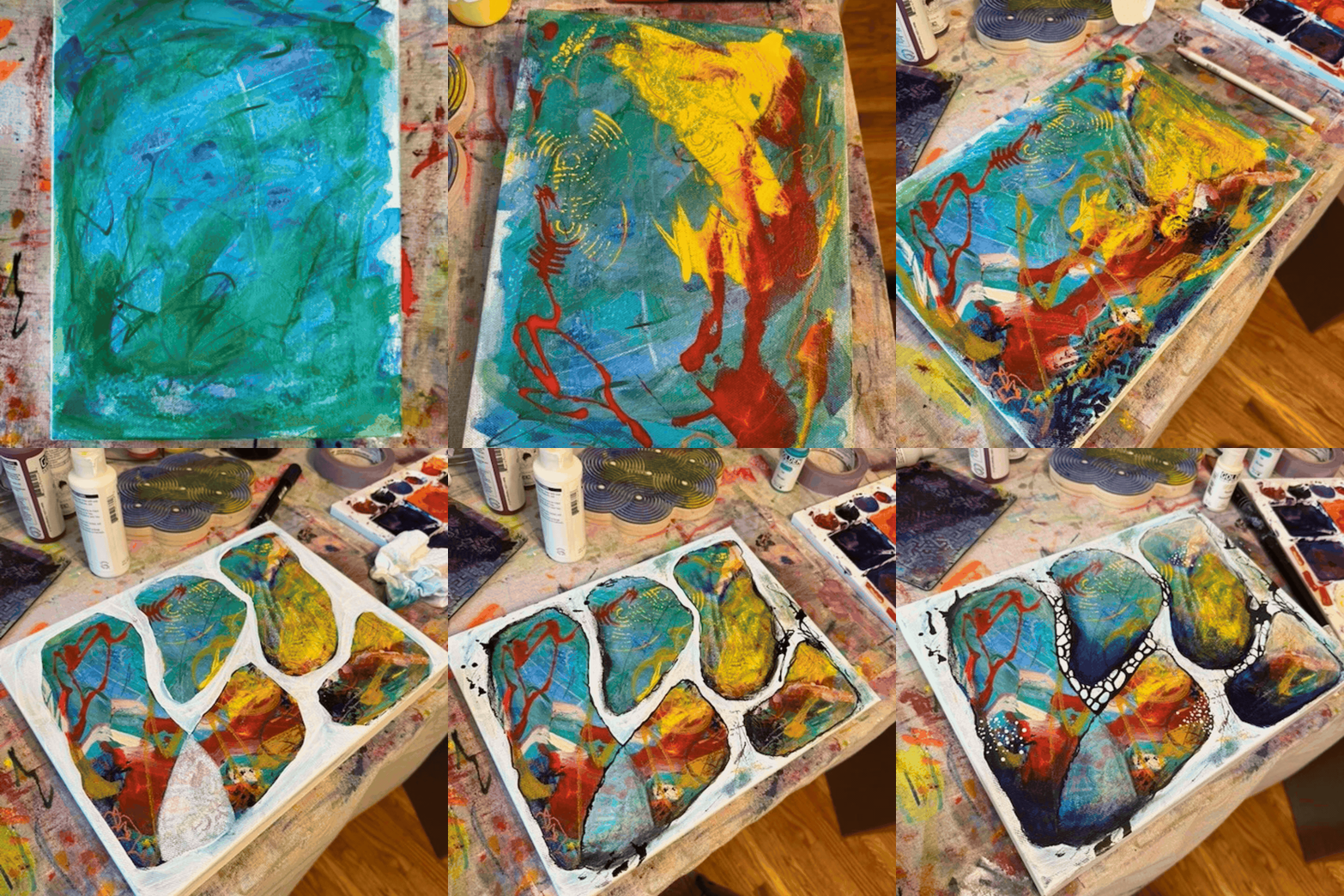
“To be wild again” (2026)