
What on earth is a giclée print? (And why I use them.)
Next weekend—June 6 and 7—I'll be doing Fairport Canal Days for the first time, and I could not be more excited about it. I'll have a full table of giclée prints, including some brand new formats and sizes. I’ll be at Booth BOA115, near the intersection of S. Main St and Fairport Village Landing and just behind the Starbucks and Bonnie and Clyde. I really hope to see you there.
If you've ever looked at a print of mine and wondered what you're actually looking at—what makes it different from something you'd print at home, or why the colors look the way they do—this one's for you.
All of my art prints are what are called “giclée prints.” The word giclée (/Ჳi.kle/ "zhee-CLAY") comes from the French verb gicler, meaning to spray or to jet liquid... which is, when you strip away the artsy mystique, exactly what's happening: ink, applied in very fine droplets, onto paper or canvas. (Oxford Art Terms, 2022). The art world borrowed the term because a) they love the French and b) "high-end inkjet reproduction" doesn't have quite the same ring.
One can imagine the meeting:
"We need a name that conveys precision, technology, and artistry."
"What about 'squirt?’"
"ABSOLUTELY NOT."
"OK, OK, what about… 'spray?’"
"Perfect. But make it French."
And so here we are.
The difference between a giclée and a home print
If you've ever printed a photo/document at home and thought “this is fine, but something's off,” you've already brushed up against the limits of consumer printing. The colors are… almost right. The paper feels thin and kinda damp after printing. Give it a few years near a window, and it starts to look like it's been through something traumatic.
The culprit, most of the time, is dye-based ink, where the colorant dissolves into a carrier fluid and soaks directly into the paper fibers. That makes for vivid output right off the printer, but dye molecules are vulnerable to light and moisture and break down faster as a result. Home printers typically use dye-based inks that are much cheaper to produce.
Giclée printing uses archival pigment-based inks instead. Pigment inks work differently: The colorant consists of tiny solid particles suspended in a carrier fluid, and those particles sit on the surface of the paper rather than absorbing into it. That surface layer is more chemically stable, which is why pigment prints hold their color so much longer (Wilhelm & Brower, 1993). Paired with acid-free fine art paper, you get a print built to resist fading and yellowing for decades—not one that starts looking tired in a few years.
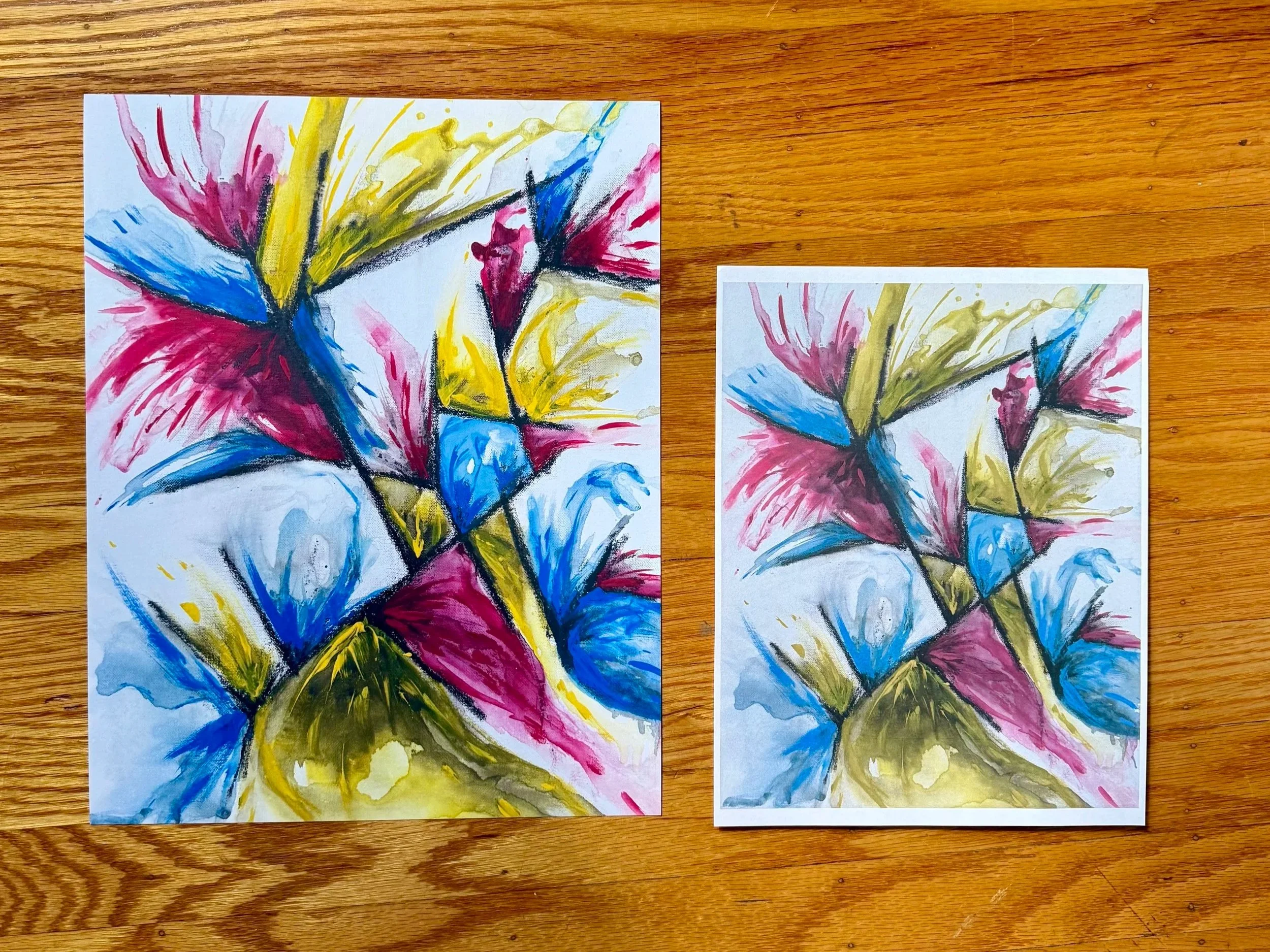
On the left is an 11×14 giclée from my professional inkjet printer. On the right is a standard 8×10 print-out on copy paper. Same digital file. Very different results.
"Acid-free" is worth unpacking a little, because it doesn't just mean the paper tested neutral when it was made. Consumer copy paper is often manufactured at (and even labeled as having) a neutral or even basic pH, i.e., “acid-free.” But it tends to become more acidic over time as the cellulose fibers break down—the paper's own chemistry works against it. The Library of Congress has documented this in its preservation research: pH-neutral, general-use papers become increasingly acidic as they age. Fine art paper for giclée printing is specifically formulated against this, typically using a calcium carbonate (alkaline) “buffer” that neutralizes acids as they form (Library of Congress, n.d.).
The printers themselves are also a different category of machine: A professional inkjet printer is capable of an extremely wide tonal range and very fine color transitions, which matters a lot when you're trying to faithfully reproduce a painting. For my work, color fidelity—specifically getting the relationships between colors right—is often the whole point (Steinmueller & Gulbins, 2013). The way one field of color sits next to another is frequently where the painting lives. Getting that right in a print isn't automatic, and these machines are built to make it possible.
Each of my giclée prints is produced individually in my studio and checked before it goes anywhere. But, before we hit the market…
What happens before the printing starts
There's a step that most people don't think about, and it's where a lot of the work actually happens.
Before any print gets made, each painting has to be captured at high resolution—photographed or scanned—to create the digital master file the printer works from. Both approaches work, but they have different tradeoffs, and which one I use depends on the painting.
Scanning is precise and eliminates the risk of glare, but it has real limitations. Flatbed scanners use directional light that can throw shadows across raised texture on a canvas surface. More specifically for my work: scanners struggle badly with fluorescent pigments, and they also tend to misread warm hues that push into fluorescent territory—the hot pinks, the bright oranges. Those colors come out dull or shifted in ways that take significant work to correct, if they can be corrected at all.
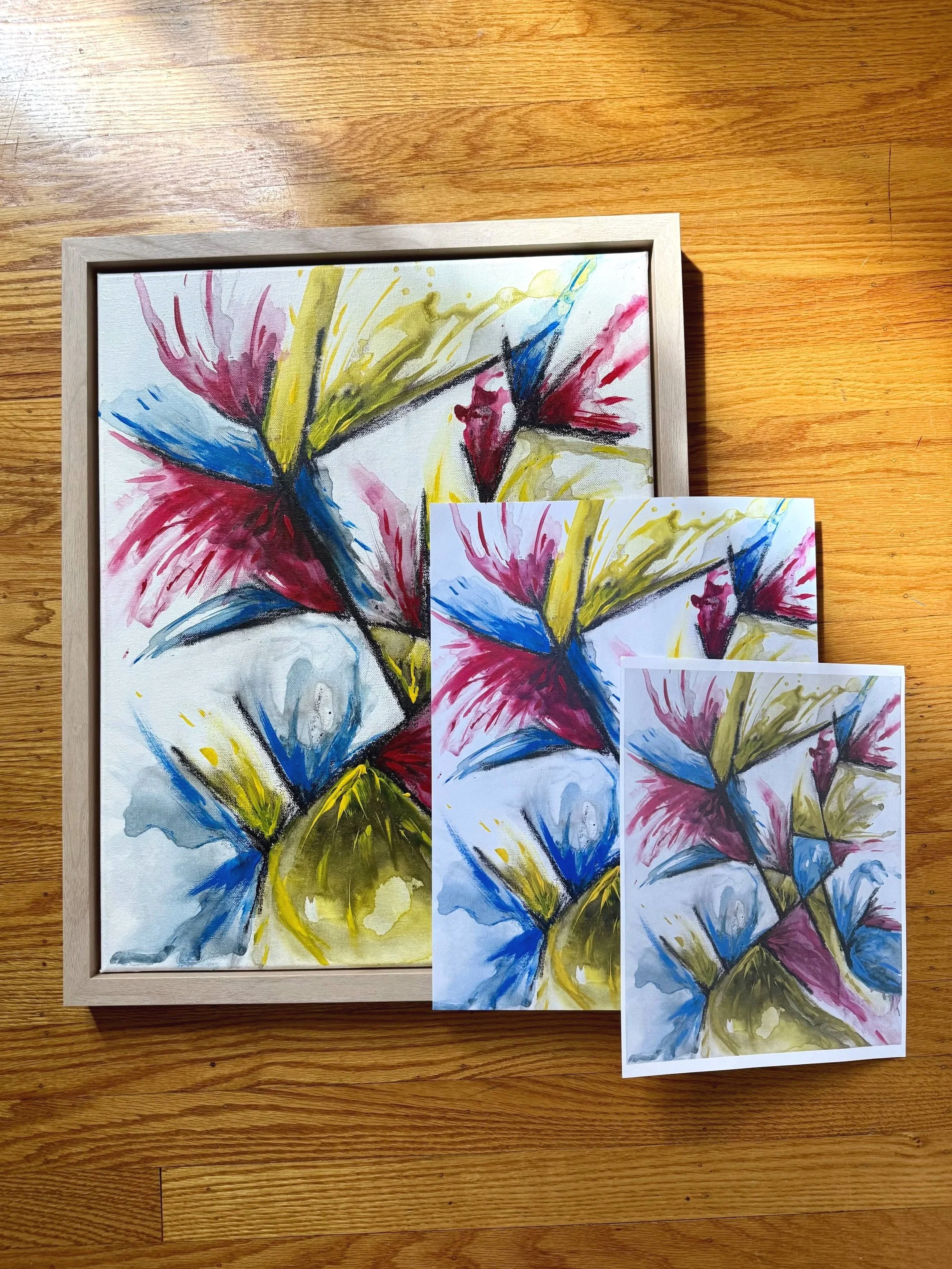
Here’s the original alongside the giclée and the copy paper print—no false advertising here! Notice how the light plays off the gessoed canvas vs. the fine art paper vs. the copy paper differently.
Photography solves those problems but introduces its own. Getting a clean, accurate photograph of a painting takes more than pointing a camera at it. The camera has to be parallel to the canvas. The lighting has to be even and neutral—two lights positioned at 45-degree angles on either side—to minimize hot spots across the surface (Gurney, 2024; Stackhouse Printery, 2025). Even a slight color cast in the light source will shift the colors of the photograph away from the original. And occasionally, no single shot is clean enough on its own; sometimes I'll photograph the same painting twice under slightly different conditions and merge the images in Photoshop to eliminate any remaining aberrations.
Once a clean capture exists, the real color correction work starts: adjusting brightness, contrast, and saturation until the digital file matches what you actually see looking at the painting in front of you under neutral daylight. Additionally, flecks of dust or small hairs can be stuck to the painting that you can’t readily see with the naked eye on the painting, but they stand out on a print and have to be removed one at a time. It takes multiple passes, and it's not something an inkjet printer can do for you (GicleeUK, 2026).
I do this tedious work myself. I'm a graphic designer by day, so working through the Adobe Creative Cloud suite is familiar ground for me. But it's a real learning curve for artists who aren't coming from that background. If you want to see how other artists approach it, the incredible abstract artist Jeannine Close has done two videos directly on this on her YouTube channel—one showing the full giclée process from painting to print, another on making art prints from originals.
I could have prints made easier and more cheaply (considering labor, materials, etc.) by an outside vendor. A lot of artists do, and there's nothing wrong with that. It just depends on what you're going for. What I kept coming back to was that I wanted to be involved in the art still. And I wanted someone to be able to hang one of my prints and have it still look right in ten years. The color fidelity mattered to me. The details and textures mattered. The longevity mattered.
Working with something this precise—getting the digital file right before anything goes to paper, seeing how close a print can actually get to the original—has become something I care about as part of the work itself.
My new canvas prints (and how they're different)
While all of the prints I make and sell are giclées, I’ve got something special I’m bringing to Canal Days next weekend.
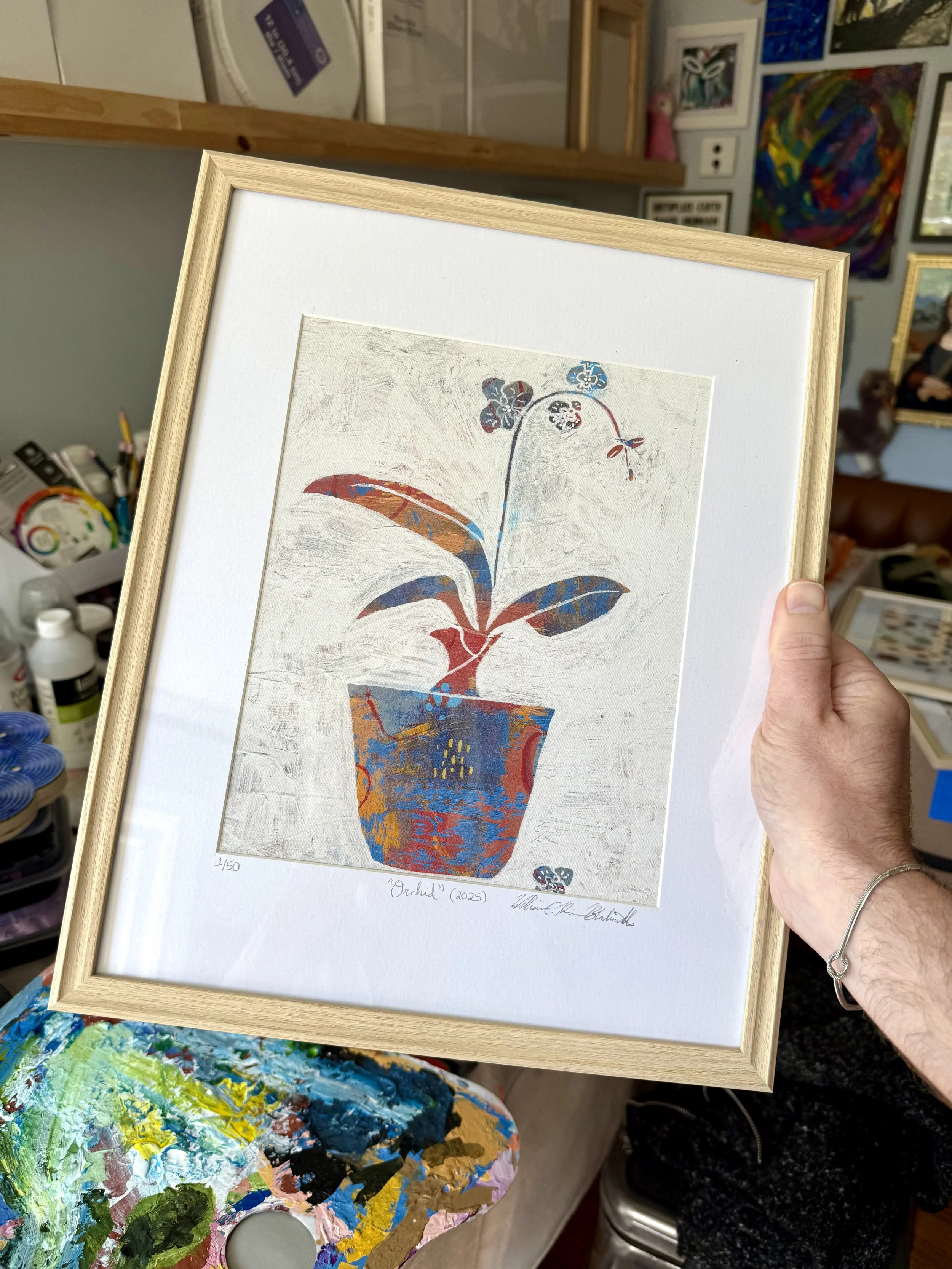
Check out that “1/50” in the bottom left corner. That’s a limited edition!
I am introducing framed canvas prints: These are giclée prints on sheets of genuine cotton canvas—not paper. They come already framed in an 11×14 mat with real glass. (I know it seems crazy to state that it’s real glass, but so many frames nowadays come with plexiglass or plastic… which is fine, but they usually feel cheaper for it.) The texture of the canvas interacts with the inks differently than even fine art paper does, and it reads much more like the original. It's a closer experience to living with a painting—with an even more accessible price tag.
Unlike my paper prints, which are open edition and have no cap on how many I'll ever print, the canvas prints are limited edition: 50 numbered prints of each artwork, ever. Once that number is reached, no more are produced—and for collectors, that defined scarcity matters. A limited edition holds its value in a way an open edition simply cannot (FinerWorks, 2025). Each one is hand-numbered, titled, and signed in graphite on the matting.
Canal Days will be the first time these are available anywhere. I hope you come take one of these French beauties home with you! And if you have questions about any of this—the process, the prints, the nerdery of it —please feel free to ask me about it when you see me!
Works Cited
Close, Jeannine. "How to Make Art Prints from Your Paintings." YouTube, 18 Apr. 2025, https://www.youtube.com/watch?v=pao6jghy-QE.
Close, Jeannine. "Turning My Paintings into Museum-Quality Prints (Giclée Process)." YouTube, 28 Sept. 2025, https://www.youtube.com/watch?v=M9GT1QRRDKk.
FinerWorks. "Limited Edition vs Open Edition Prints." FinerWorks Help and Support Portal, Jan. 2025, https://support.finerworks.com/help-my-prints/limited-edition-vs-open-edition-prints/.
"Giclée." Oxford Art Terms, Oxford University Press, 2022.
GicleeUK. "How to Photograph or Scan Your Artwork for High-Quality Prints." GicleeUK, 17 Mar. 2026, https://gicleeuk.com/how-to-photograph-or-scan-your-artwork-for-high-quality-prints/.
Gurney, James. "Tips for Photographing Paintings." James Gurney, Substack, 11 Dec. 2024, https://jamesgurney.substack.com/p/tips-for-photographing-paintings.
Library of Congress. "The Deterioration and Preservation of Paper: Some Essential Facts." Library of Congress Preservation, https://www.loc.gov/preservation/care/deterioratebrochure.html.
Stackhouse Printery. "How to Digitize Your Artwork for Professional Printing." Stackhouse Printery, 15 Dec. 2025, https://thestackhouse.com/blogs/printery-press-blog/scan-or-photograph-art-for-printing.
Steinmueller, Uwe, and Juergen Gulbins. Fine Art Printing for Photographers: Exhibition Quality Prints with Inkjet Printers. 3rd ed., Rocky Nook, 2013.
Wilhelm, Henry, and Carol Brower. The Permanence and Care of Color Photographs: Traditional and Digital Color Prints, Color Negatives, Slides, and Motion Pictures. Preservation Publishing Company, 1993.