
The painting I made when everything fell apart.
A lot of us picked up something during the pandemic that we'd always meant to try. Sourdough, a language, an instrument, a garden. I'd painted before—in high school art classes and occasionally after that, the way you return to something every few years without it ever becoming a real part of your life. What the pandemic gave me wasn't painting: It gave me a practice. Somewhere in those early months of COVID-19, between the fear and the stillness and the sudden abundance of unstructured time, I picked up a brush and didn't really put it down again. I fell hard for abstract painting specifically, and for acrylic on canvas.
The paintings were vivid, bold, without apology. The “studio” where I painted them was none of those things—and had plenty to apologize for.
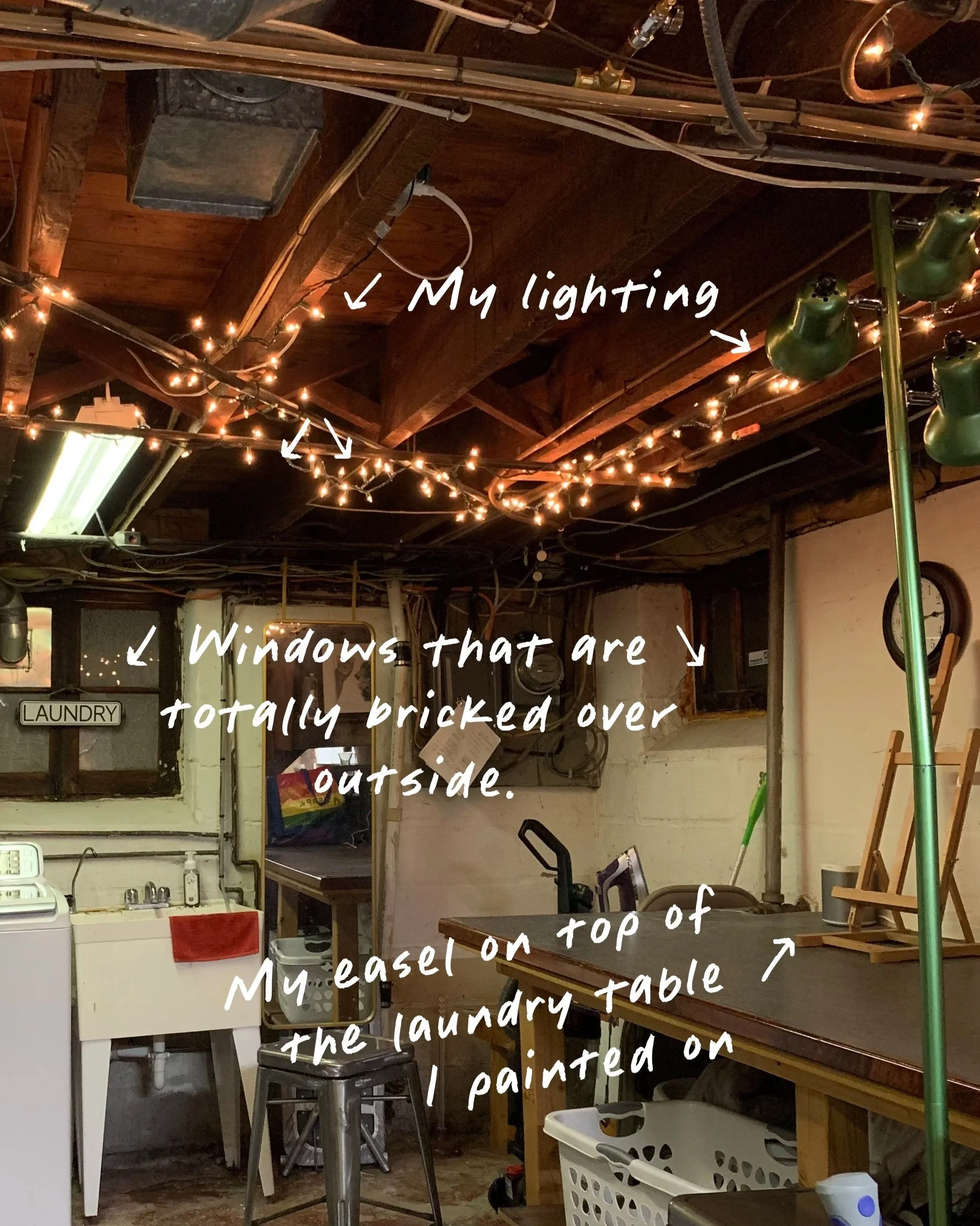
My picturesque pandemic studio…
Century-old block walls, cracking rocky floor, water leaks, the occasional spider web (and, more than occasionally, the spiders). It smelled like a century-old basement…which is to say it smelled like time and moisture and things you'd rather not identify. One tiny window let in a few inches of natural light early in the morning, useless to me since I was working during those hours. The other “windows?” Bricked over at some point from the outside. I made do with a lamp and a string of Christmas lights I'd hung up just to see what I was doing. The contrast between what I was making and where I was making it still strikes me. Something about that felt right, actually.
Further into the pandemic, the world had shrunk to the size of whatever you'd managed to hold onto. For me, that was a relationship. My partner and I had first “bubbled” together and then moved in together. He was my primary source of daily human connection, the way that only made sense in that particular strange moment in history.
I knew, after one particular conversation, that I had to end it. Which also meant losing the only face-to-face contact I had.
I was upstairs, crying, when a composition came to me. Not gradually—all at once. Color, shape, medium. This had never happened to me before, and the sheer shock of it stopped my crying. I wiped my face, went downstairs, and made the painting.
It wasn't until later that I understood what had happened. Abstract painting had given me somewhere to put something I couldn't yet put into words. Not an exhaustive symbolic catalog of feelings or thoughts or ideas, but all of them at once. The whole painting, together, was the experience.
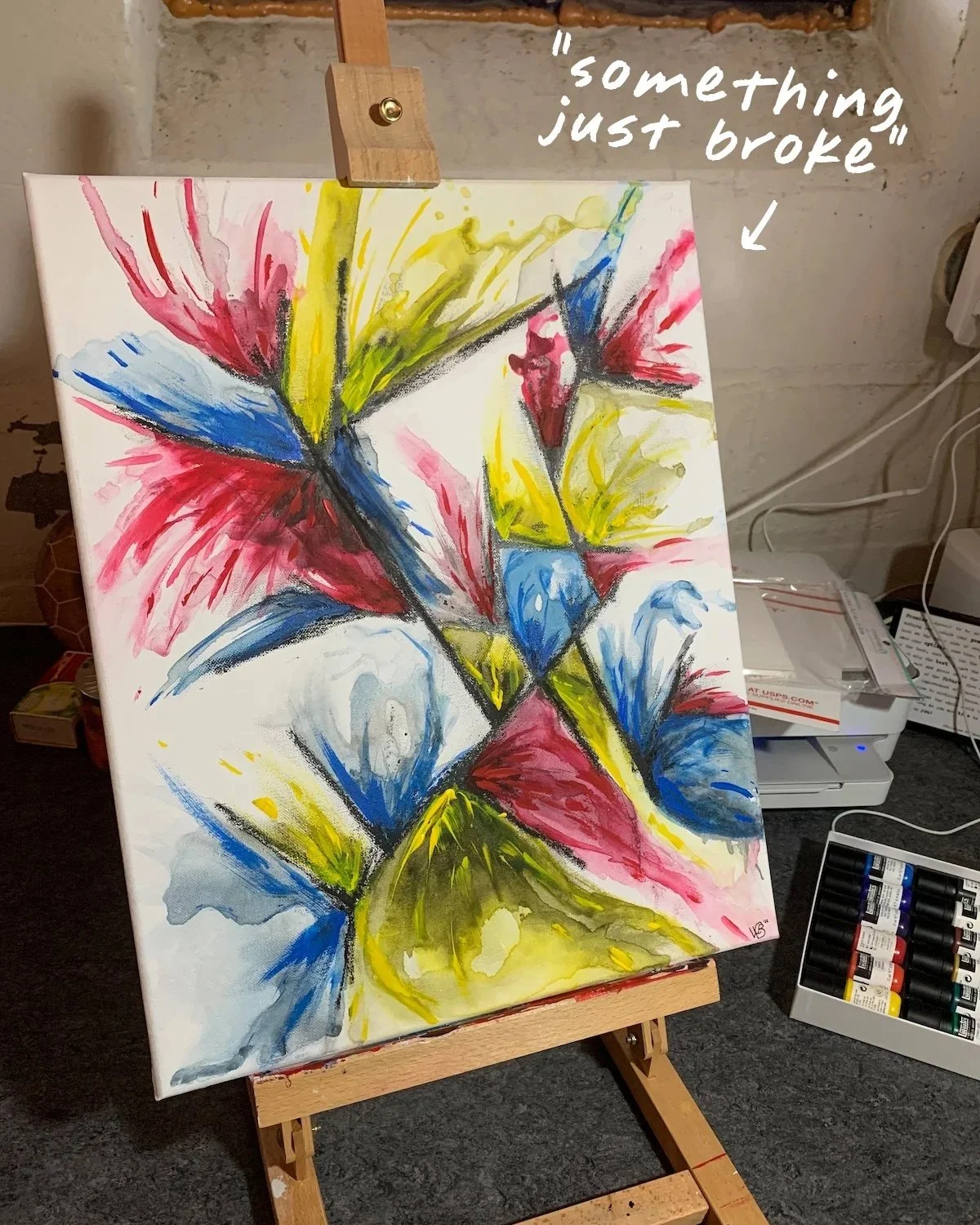
The painting I made that day
That's what abstract art does that nothing else quite manages: It doesn't visually present directly or symbolically as much as it passes experience from one human to another in some deeper language beyond language.
This painting has been hanging in my home since. I've been fortunate enough to sell a number of pieces over the years, and it's always a little bittersweet, even when it shouldn't be. You're happy that someone wants to live with your work in their home. And then it's gone, and you realize you won't get to see it anymore. But something just broke is the one I already know I'll never be able to part with.
I've been painting ever since. And in the years of layers and mistakes and occasionally surprising myself, I've learned some things I wish someone had told me earlier.
The first layers are not the painting. They are the possibilities, the places the painting could go next. It doesn't grow in straight lines. If what you're looking at right now seems wrong or strange or unfinished, that's not a signal to stop. That's the messy middle. It means you're not done yet.
You also can't ruin a painting. There is always more to do: more to add, more to cover, more to uncover underneath. What looks like a mistake is almost always just the next layer asking to be made.
Inspiration hadn’t visited me that day on a whim or only because I was emotionally wrung out: It visited because I had already established a practice of creating.
And the thing that changed everything for me specifically: there isn't a 1-to-1 relationship between the feeling you're trying to capture and the marks, shapes, and fields of color you put down. It's that the whole piece together becomes the feeling. You're not illustrating something. You're constructing it.
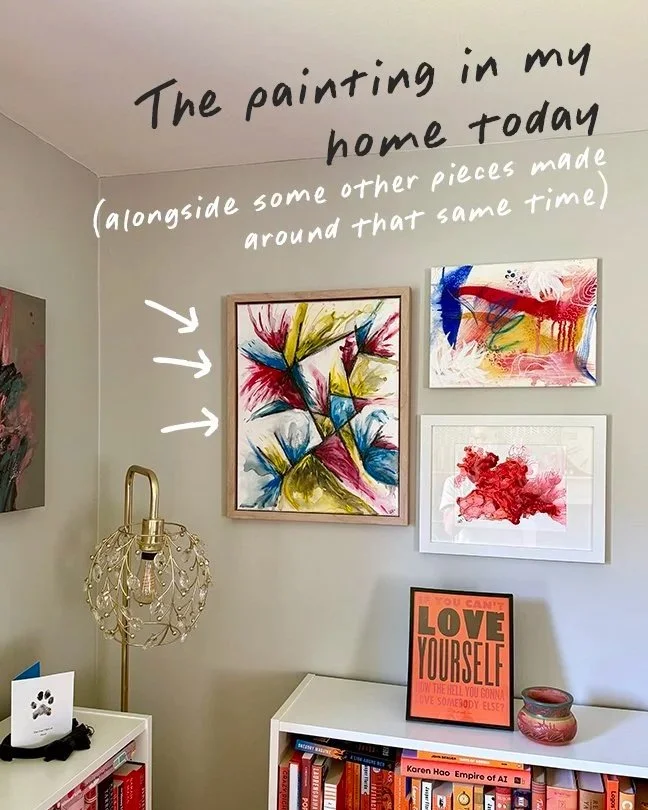
She’s had a glow-up since with varnish and framing… and gained some friends!
It’s extremely liberating…once it clicks.
On Monday, June 22 at 6pm, I'm teaching my first class for the Rochester Brainery—Introduction to Abstract Painting—at the Arc + Flame Center in Gates. I'd love for you to be there.
I'll teach you a process that moves back and forth between intuitive, free creation and considered composition: Too much of one leaves you with something stiff and predictable, and too much of the other leaves you with pretty chaos your eye doesn't know how to process. The class gives you the structure to find the balance and something to take home when you do.
You'll leave with a finished, expressive acrylic painting on canvas ready to hang, a "cheat code" deck for when you get stuck, and a repeatable process that's yours to keep.
$55. 2.5 hours. All materials included.
A lot of us picked something up during the pandemic and put it back down when life reopened. Abstract painting can feel like a strange on-ramp if it isn't already your thing. But learning to create without your inner critic running the show carries further than the canvas.
Whatever creative thing you've been meaning to return to, or try for the first time, this is a pretty good place to practice that.